

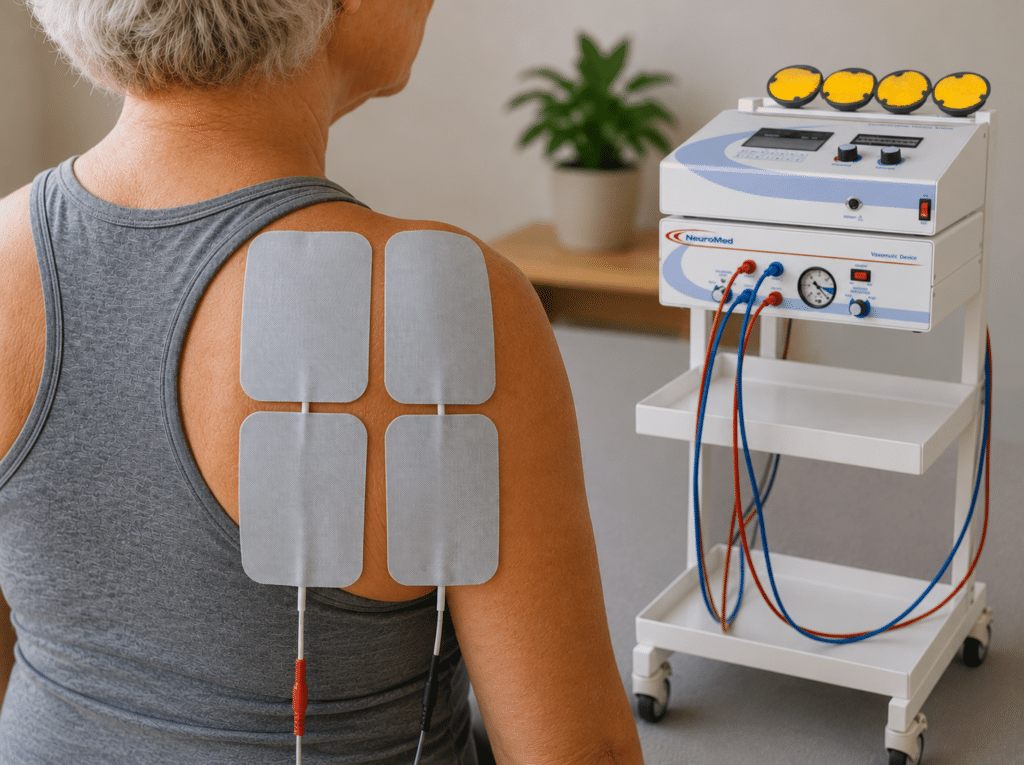
Why Effective Pain Treatment Should Address More Than Discomfort
For people living with chronic musculoskeletal pain, feeling better is important—but it is rarely the only goal.
Patients may also want to walk farther, sleep more comfortably, return to work, care for family members, exercise, or complete daily tasks with greater independence.
That is why pain research frequently measures two separate outcomes:
- How much pain a patient experiences
- How well the patient is able to function
Research into electrical stimulation therapies suggests that some modalities may support improvements in both areas.
What Is Electrical Stimulation Therapy?
Electrical stimulation is a broad category that includes several treatment technologies.
Examples include:
- Interferential current therapy
- Transcutaneous electrical nerve stimulation
- Neuromuscular electrical stimulation
- Microcurrent stimulation
- Percutaneous electrical nerve stimulation
- Certain forms of peripheral nerve stimulation
These therapies differ in their electrical frequencies, intensities, delivery methods, treatment goals, and supporting evidence.
They should not be treated as interchangeable simply because they all use electrical stimulation.
What Did the Comparative Research Find?
A 2023 comparative review examined multiple electrical stimulation devices intended to reduce pain, improve function, or support rehabilitation.
The authors reviewed therapies including interferential current, TENS, neuromuscular electrical stimulation, H-Wave stimulation, pulsed electromagnetic therapies, microcurrent stimulation, peripheral nerve stimulation, and several other technologies.
The review found evidence that a number of these approaches may reduce pain and improve function, although the quality and quantity of supporting research differed substantially among devices.
An earlier systematic review comparing TENS and interferential current similarly reported that both treatments produced reductions in pain and positive functional outcomes on commonly used disability and osteoarthritis questionnaires. The authors did not find a clear difference in pain reduction between the two modalities.
Why Function Is an Important Outcome
A lower pain score does not always mean that a patient is moving better or participating more fully in daily life.
Functional outcome measures may evaluate whether a patient can:
- Walk or stand for longer periods
- Bend, lift, or reach more comfortably
- Use an affected joint
- Complete household responsibilities
- Participate in rehabilitation
- Return to work or recreation
- Maintain personal independence
When a study reports improvements in both pain and function, it suggests that the treatment may be affecting more than the patient’s perception of discomfort.
How Pain Relief May Support Better Movement
Pain can create a cycle of reduced activity.
When movement hurts, patients may naturally begin avoiding it. Over time, reduced activity can contribute to stiffness, muscle weakness, decreased endurance, and greater fear of movement.
By reducing pain, electrical stimulation may help some patients move more comfortably and participate more fully in therapeutic activity.
This does not mean that stimulation alone rebuilds strength or restores mobility. Rather, pain relief may create an opportunity for patients to engage in the movement and rehabilitation needed to improve function.
The Evidence Is Not Identical for Every Therapy
The phrase “electrical stimulation” includes many different devices and treatment methods. Some have been examined in numerous randomized trials, while others are supported by smaller or lower-quality studies.
Researchers have also identified important limitations, including:
- Small participant groups
- Different treatment protocols
- Short follow-up periods
- Inconsistent comparison groups
- Variation in the conditions being treated
- Differences in how pain and function are measured
As a result, it would be inaccurate to say that every electrical stimulation therapy consistently produces the same results for every musculoskeletal condition.
What This Research Means for Patients
The overall research suggests that certain electrical stimulation therapies may help reduce pain and support improvements in function for some patients with chronic musculoskeletal conditions.
The most appropriate technology and treatment plan depend on the patient’s diagnosis, medical history, symptoms, functional limitations, and individual goals.
Electrical stimulation is generally best viewed as a potential component of comprehensive care rather than a replacement for all other treatment.
Research takeaway: Comparative reviews suggest that several electrical stimulation therapies may improve pain and functional outcomes. However, the strength of evidence varies by device and condition, and more standardized, long-term research is needed.